

What Baroness Casey’s message at NCASC means for councils
- 16th November 2026
- Laura Power-Wharton
- No Comments

What Baroness Casey’s message at NCASC means for councils
“No-one in charge”. Reflections from NCASC, Liverpool
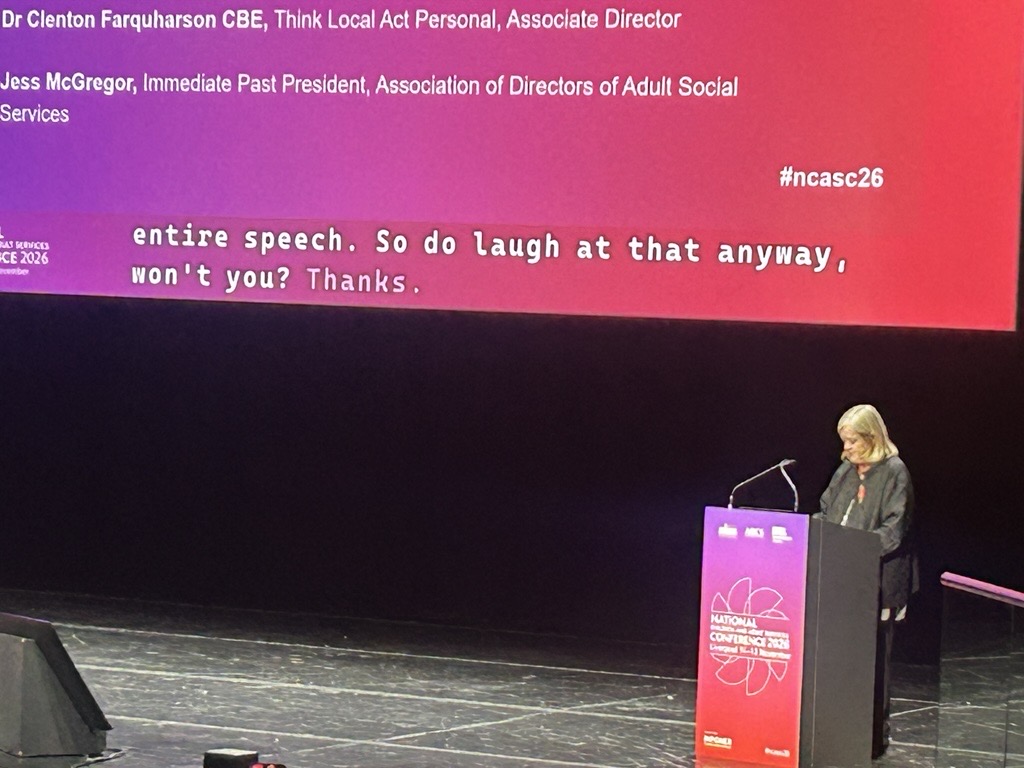
Baroness Louise Casey’s speech at this year’s National Children and Adult Services Conference was, for me, a big highlight of the event. I found it genuinely inspiring, and for the first time in a while it felt like adult social care was getting the focus it needs and warrants.
Casey didn’t soften her diagnosis: social care in England has no one in charge. Responsibility is spread so widely that, in practice, no one is responsible, and successive governments have been ‘asleep at the wheel’.
Her speech coincided with new research for her Commission by the Nuffield Trust and Institute for Government, ahead of a final report due in summer 2027. For those of us working with councils on adult social care, the message was sobering but, unexpectedly, energising.
A system without a steward
The research confirms what many in the sector already feel. Social care never had a founding moment like the NHS in 1948. It grew ad hoc, through sticking plasters and workarounds, leaving responsibility split across government departments, arm’s-length bodies, national and local government and a wide range of providers, with no single point of oversight.
The consequences show up in people’s lives. Your experience of assessment, waiting times and support depends on where you live. The provider market, dominated by private provision, developed largely by accident. And transparency is poor – the CQC oversees the finances of around 65 of the largest providers, roughly 30% of the market, but can only step in to manage a collapse, not prevent one, a role described to the researchers as being a ‘spectator at the site of a car crash’. Homecare, with its rapid churn of providers, is especially fragile.
The unseen workforce
Casey reserved some of her strongest words for care workers, who are one of the country’s biggest workforces, yet unseen, unchampioned and not recognised as professionals. More than 1.5 million people work across around 19,000 employers, and England is the only UK nation without a mandatory register of care workers. She called for a proper career pathway and said the Commission will put significant pressure on the forthcoming workforce strategy, which cannot come soon enough.
Hard truths about who pays
England is an outlier internationally – eligibility for any state funding depends on both your needs and your financial means, concentrating support on those with the highest needs and lowest means. Most other countries base eligibility for some state-funded care on need alone, often then applying a means test to set the individual’s contribution, so people with care needs generally get some state support. Casey asked why we aren’t more honest with people, many of whom have contributed all their lives, about what they’ll be expected to pay.
That means confronting hard truths about what kind of system we want. Pointedly, Casey referred to the NHS as the “National Hospital Service”, a reminder of how far the health service’s weight has tilted priorities towards acute care while social care has gone unseen. Her framing was a new settlement for care, built on decency, contribution, and a shared duty to care for our families, neighbours and ourselves.
She also welcomed the Prime Minister’s proposed changes to the pensions triple lock to help fund a National Care Service, something she had pushed for, as a major win for social care with billions of pounds attached.
Local government must stop accepting powerlessness
For councils, this was the most striking part of the session. Casey argued that local government too often accepts a sense of powerlessness it doesn’t need to. It is the democratically elected tier closest to people’s lives, and councils can combine data with street-level intelligence to predict trends and lead change.
Casey urged councils to use the levers they already have – open book contracting, actively cultivating good care providers, and being willing to run services themselves and take pride in doing so. The discussion touched on Medway Councils efforts to build its own care home, and the friction such invest-to-save approaches can meet with accounting conventions. But individual councils shouldn’t have to go it alone. Without an overarching framework, it is harder than it should be to ask why more provision isn’t not-for-profit or publicly run.
National and local, not national versus local
A National Care Service doesn’t have to mean a contest between Whitehall and town halls, but it does need clarity. The public needs to understand what social care is, what they are entitled to, and what they are paying for. As Casey put it, you can’t ask people to pay for something they don’t understand. Equally, reform should not break parts of the system that already work.
A movement, not just a report
There have been 22 reviews of social care since 1997, and Casey wants this one to be different. Recommendations will be consulted on, not agreed behind closed doors, and she wants the sector to see its own hand in them. Get it right, she argued, and the case becomes so obvious it simply gets approved, building cross-party support along the way.
What this means for councils now
The final report is still months away, but councils don’t need to wait. The direction of travel is clear: stronger stewardship, a more transparent provider market, a professionalised and valued workforce, and local government as an active shaper of care rather than a passive purchaser. Councils that start now, by understanding their market’s true costs and fragilities, testing open book and alternative delivery models, and using local intelligence to plan ahead, will be best placed to shape the settlement rather than simply receive it.
Working with 31ten
At 31ten, we work alongside councils on exactly these questions, from front door redesign to market sustainability and third-party spend.
If you’d like to talk about what the Casey agenda means for your authority, drop me a note using my contact details below.
Contact
