By Jenny McArdle, Director, 31ten
It’s budget-setting season, and as a senior leader in local government, you and your sector peers will be asking your teams the same question – where can I find savings? Increasingly, the answer that comes back isn’t savings – it’s pressures. And therein lies the challenge. That’s the pattern we are seeing across many councils.
Our Director, Jenny McArdle sets out her recommendations for change in this blog.
The numbers don’t add up
Take a real example: next year’s budget growth figure – the additional costs as a result of inflation, pay awards, and rising demand – is £30m. The savings target sitting alongside is £6m.
Close that £6m gap and, on paper, you’ve balanced the books. But the problem hasn’t shrunk, you’ve just funded millions of assumed growth without stress testing whether all of it is real.
We’re seeing this play out in many councils. Ask services for savings and growth bids together, and it’s not unusual to get back more in new pressures than in cashable savings, which leaves the council in a worse net position than before the question was asked.
The question is – how much of our growth is genuinely unavoidable?
Five levers to push further
We know councils have often made the obvious changes to reduce costs and demand. And typically feel they have exhausted all options. In our experience, there is more that can be done.
Our five levers model focuses around key areas which still offer some mileage. None of them is entirely new but they can all be pushed a little further to support financial sustainability:
- Prevention – reducing demand upstream, particularly in people-based services – but with greater targeting based on data and intelligence.
- Assets – taking a strategic, commercially minded view of property and land – and even extending the same to social and cultural assets.
- Markets and commercial – commissioning smartly, rethinking procurement and the relationship with the market, managing contracts, maximising fees and charges, and ensuring cost recovery.
- Data and digital – using technology not only to reduce demand and waste, but to completely reimagine how the work gets done, covering everything from the front door to enabling services to adult social care to SEND and TA.
- Workforce – redesigning roles and ways of working, rather than simply reducing headcount. And giving equal attention to the behaviours, especially at a leadership level.
They don’t sit neatly with one service. Assets are driven by costs incurred across the whole organisation. Prevention crosses adults, children’s, and housing. That’s often exactly why progress stalls within councils – because no one person or directorate owns the opportunity end to end. They need a cross organisational approach that understands the people and the place, with senior leaders stepping out of service silos.
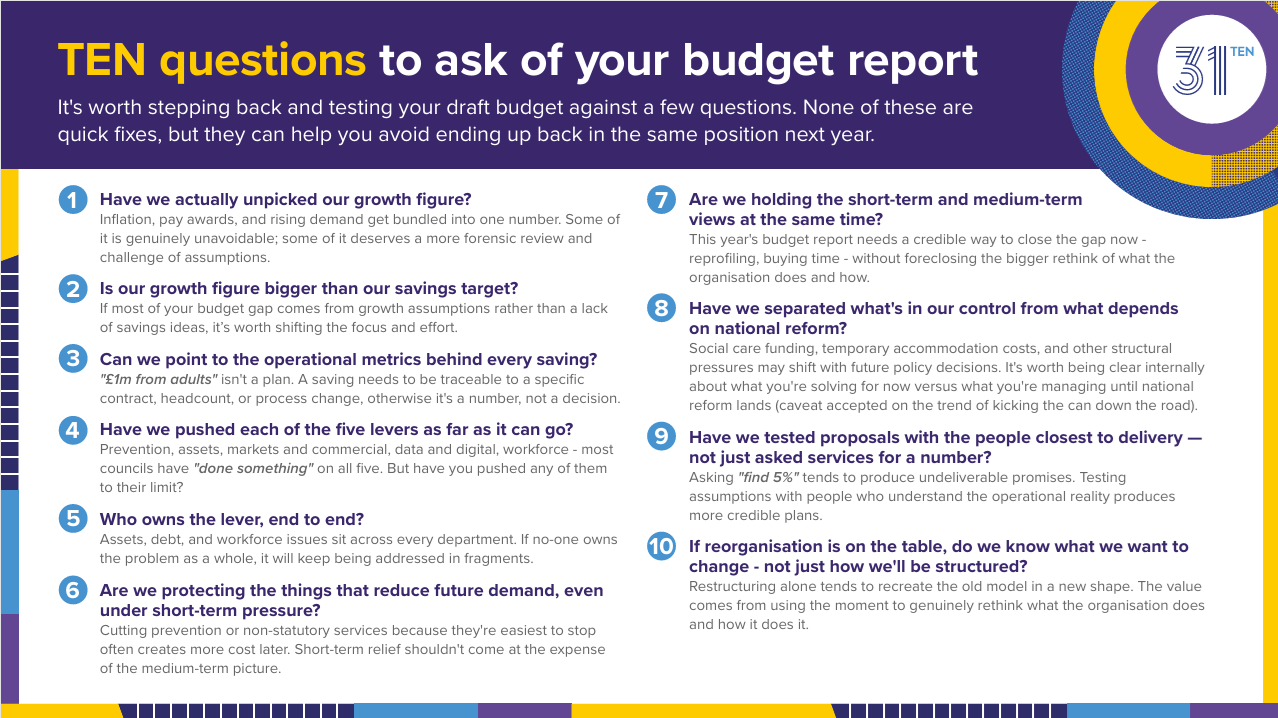
TEN questions to ask of your budget report
It’s worth stepping back and testing your draft budget against a few questions. As previously mentioned, there are no quick fixes, but asking these questions can help you avoid ending up back in the same position next year.