

Across the country, decisions on local government reorganisation are landing. Structures are being confirmed, shadow authorities are forming, and a wave of councils are moving from the decision phase and into the delivery phase.
In this blog, written by Laura Bridges, Director and LGR lead at 31ten, Laura sets out key considerations for councils facing LGR, when moving from ‘whether it will happen, to how it happens’.
Mobilising a new authority
It’s unlikely you are starting from a blank page. MHCLG has shared a list of preparatory actions and sector-support resources with councils, covering activities you could work on between submitting proposals and getting a final decision on area footprints.
This is certainly the right starting point and needs to happen, however it doesn’t on its own address some of the key challenges or help answer the harder questions that are fundamental in designing a new and transformed organisation. Some of these key questions ought to be:
- What happens to growth ambitions and who owns a shared view of priorities?
- What happens to existing partnership arrangements?
- What is the organisational culture we want to cultivate and how do we embed this from day one?
Don’t let ‘safe and legal’ become the goal
As an authority going through reorganisation, it’s likely you’ll be working towards the same non-negotiable outcome as all the other authorities navigating LGR: establishing a new organisation that is safe and legal on day one; payroll runs, statutory duties are met, services keep operating and importantly, nothing falls over!
That’s the right immediate priority. But it’s also where the risk sits. Safe and legal is a starting point. It should be seen as the minimum bar for a functioning organisation, and not the final goal.
We’re seeing authorities pour so much capacity into hitting that safe and legal point that there’s little left to challenge the status quo – are you building something better, or just relabelling what previously existed?
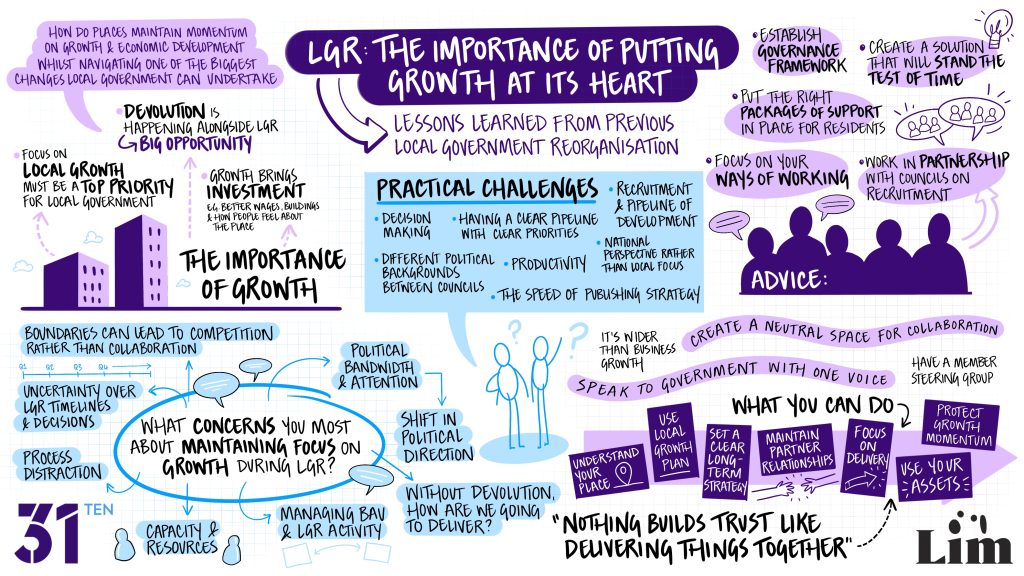
At our recent roundtable featuring speakers from Enterprising Cumbria and Oxfordshire County Council, who have already been through LGR, their experts view was clear – reorganisation is one of the few moments an authority gets to genuinely reset how it works – its operating model, its governance, its relationship with growth and investment, its culture.
The graphic below summarises the roundtable discussion. Read full detail in this short whitepaper.
Use LGR as an opportunity for improvement
In our experience working with local authorities across the UK, a handful of things seem to separate authorities that use the moment and opportunity of LGR well.
- They hold onto a single, shared narrative on growth and investment through the transition
- They settle governance and partnership arrangements early and deliberately
- They keep stakeholders – communities, businesses, investors, partners, engaged and confident throughout
- They treat the transition as a genuine opportunity to redesign services
- They build financial sustainability into the holistic design of the new authority from the outset.
The decisions ahead matter more than the ones behind.
Five things to get right early
The structural decisions – which councils merge, what the new authority is called, when it goes live – get the attention because they’re the ones with dates attached to them.
But the decisions that will actually determine whether reorganisation delivers better outcomes for a place are the ones still ahead:
- How governance really works day to day
- What growth and investment priorities survive the transition intact
- Whether services get redesigned or just relocated
- Whether the new organisation is financially sustainable from the outset rather than playing catch-up.
Getting to day one safely is necessary. But it isn’t the finish line. The authorities that will look back on this period as a genuine turning point for their place are the ones treating it that way now – while there’s still time to choose what comes next.
The things that are worth prioritising now:
- Get a shared, single narrative on growth and investment before it gets lost in transition
- Build one governance and partnership model early
- Don’t let stakeholder trust erode while attention is on structures
- Use the reset to actually redesign services
- Treat financial sustainability as a design principle
How 31ten can help
Get in touch to talk through where your organisation is in the reorganisation process, and how we can help you use this reset to build the foundations for what comes next.
