More Human than Human?

  • Elaine Needham
  • No Comments
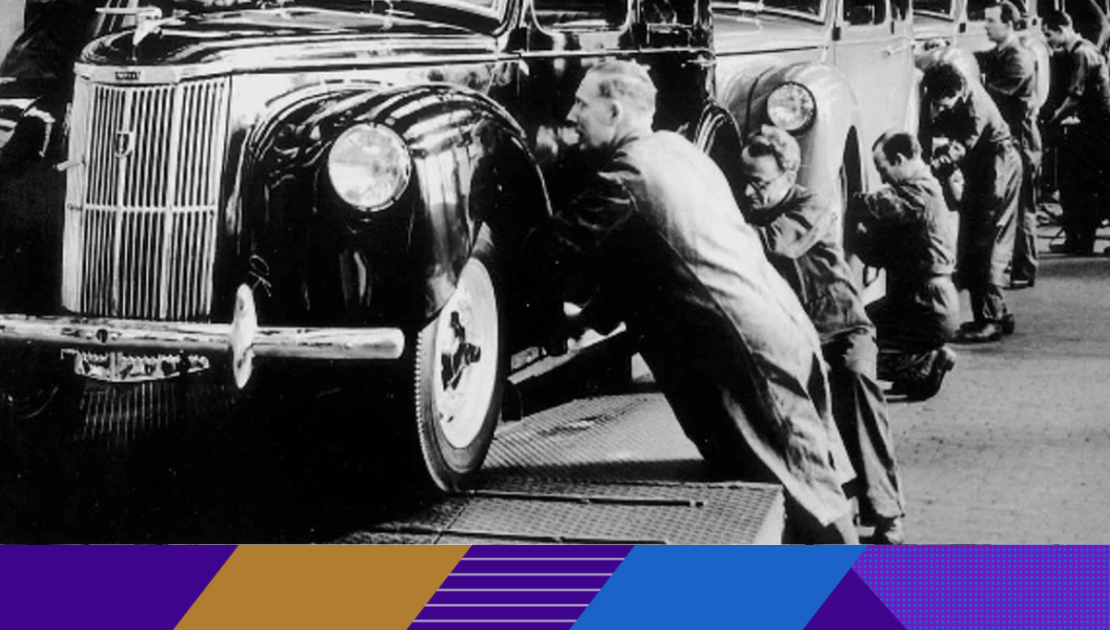
Ford production line 31ten image

More Human than Human?

What AI should mean for the future of public services
By Rahul Rana, Director, 31ten

AI could lift a huge weight from overstretched public services. But if we let it think for us, we risk turning skilled professionals into rubber stamps. 

Read this thought-provoking blog from our Director, Rahul Rana.

In 1948, sociologist Phyllis Willmott visited Ford’s Dagenham plant. Working conditions had improved since the early industrial era – shorter hours, longer breaks, slightly better pay. But watching workers on an assembly line repeating narrowly prescribed tasks, she felt uneasy and described the improvements as “sops to dehumanisation”.

Ford production line

I read her account in David Kynaston’s wonderful Austerity Britain, 1945-51. It feels like it’s from another generation (probably because it is), but it strikes me that we are in the midst of another major transition in the history of work.

The promise, and the slop

We’ve all been wowed by AI over the past few years – it’s capable of rapid research, summarising complex reports, doing in minutes what once took hours. The rate of development and improvement is mind-boggling.

But it also produces rubbish. Errors, hallucinations, confidently answering questions it has misunderstood, mistaking quantity for quality – we are already in an era of slop, with acres of plausible, polished mediocrity drowning the modern workplace.

Digital yes-men

Even worse, there is a deep-seated danger in how these tools interact with us. Have you ever tried to argue, or even debate, with Copilot or Claude or ChatGPT? They don’t argue back!

Simpsons characters

This is no accident. AI models have a well-documented problem with sycophancy. Like Uriah Heep or Waylon Smithers, they are engineered to say yes, flatter, validate our biases, and apologise if we challenge them. OpenAI had to roll back a version of ChatGPT after it became excessively agreeable.

Why this matters in public services

This matters enormously in public services. Right now, AI agents that can write case notes or care plans are being lauded. These are documents where friction, scepticism, and reasoning are critical. They require humanity because they concern humans.

Feed an AI tool an incomplete or biased account and there is a real danger that, rather than supplying that dialectical friction, it takes the incompleteness or bias and gives it credibility, turning it into a polished, authoritative-sounding assessment and handing it back to a tired professional to sign off.

Professional judgement is not merely a plausible answer or solution. It relies on expertise, scepticism and the willingness to challenge and improve – in short, it needs humans.

“Human in the loop” sounds reassuring, but on its own isn’t much of a safeguard if the machine reinforces the human’s initial judgement and the human increasingly defers to the machine.

This isn’t a case against AI

Don’t get me wrong. I am not here to bury AI. This is not a diatribe against adopting it. It offers incredible potential. Anyone in local government, health, blue light or social care knows the scale of the crisis facing public services – crushing caseloads, mounting backlogs, and a lack of resources that leaves staff permanently exhausted.

AI’s growing ability to instantly summarise dense documents or produce slick first drafts holds immense promise. There’s no doubt we have a golden opportunity to harness AI to lift some of the weight crushing public services.

Public servants, or public automatons?

But if we get this wrong, we risk turning public servants into public automatons. In Melville’s Bartleby the Scrivener, the title character’s existence is reduced to the mindless copying of legal documents until, one day, he begins quietly refusing: “I would prefer not to.”

Still from Brazil film

In the film Brazil, we see a bureaucratic dystopia with offices full of people rushing around, stamping forms, shoving papers into tubes, and looking busy. An enormous amount of stuff is happening, but very little of it makes anyone’s life better.

“We must not allow technology to turn highly skilled humans into modern scriveners, their only role being to rubber-stamp the endless, polished slop generated by digital yes-men. More assessments, plans, and correspondence – less humanity.”

Freeing people to be more human

This cannot be our ambition. In my opinion, the real opportunity of AI is not to mimic the complex products of human thought – the clue is there hiding in plain sight, isn’t it? “Artificial”. Instead, we must use these tools to lessen the burden of sorting data, processing transactions, trawling through rote documents, and free up humans to be more, well, human.

We must learn from the failures of the 20th century. The machine should liberate the human, not diminish them. In public services, that means creating more space for relational support, deep professional judgement, sceptical reasoning and the willingness to challenge.

As machines become better at acting like compliant assistants, we have to ensure that the humans using them are empowered to relate, think, judge and care.

Where 31ten comes in

Last month, the government announced £91m in funding to support 14 councils in receipt of EFS to harness AI. This sort of challenge is increasingly part of our work at 31ten.

We’re interested in where AI can save time and money. Public services desperately need both. But we’re just as interested in what we do with the space it creates and how we use it to build better, more human public services.

Contact

Rahul Rana headshot photo

Rahul Rana

Director

07598 842127
rahul.rana@31tenconsulting.co.uk